Wide-Angle Photography
Wide-angle photography is one of the most demanding disciplines underwater. This page explains the optics behind the dome port planner and summarises my tests of the lenses and domes I use.
1. Choosing the lens
An ideal underwater wide-angle lens is sharp from centre to edge, small enough for the housing, focuses fast and, above all, focuses close. A short minimum focus distance is what makes close-focus wide-angle (CFWA) possible.
Of the Nikon Z lenses, four are relevant underwater: the Z 14–30 f/4, the Z 17–28 f/2.8, the Z 20 f/1.8 and the F-mount Fisheye 8–15 (on the FTZ). The Z 17–28 focuses closest of the rectilinear lenses, and the fisheye, with or without the Kenko 1.4× teleconverter (which turns it into an 11–21 mm fisheye zoom), gives the highest magnification:
| Lens | Closest focus (from the sensor) | Max. reproduction ratio (in air) |
|---|---|---|
| Z 14–30 f/4 | 28 cm | 0.16 (at 30 mm) |
| Z 17–28 f/2.8 | 19 cm (17 mm) – 26 cm (28 mm) | 0.19 (17 mm), 0.17 (28 mm) |
| Z 20 f/1.8 | 20 cm | 0.19 |
| Fisheye 8–15 | 16 cm | 0.17 (8 mm) – 0.34 (15 mm) |
| Fisheye 8–15 + 1.4× TC | 18 cm | 0.33 (11 mm) – 0.49 (15 mm on the ring) |
The TC moves the lens about 2 cm forward, so the closest focus measured from the sensor grows only slightly, while the magnification rises by the factor 1.4. I therefore concentrate on the Z 17–28 and the 8–15 and their domes.
2. Dome port geometry
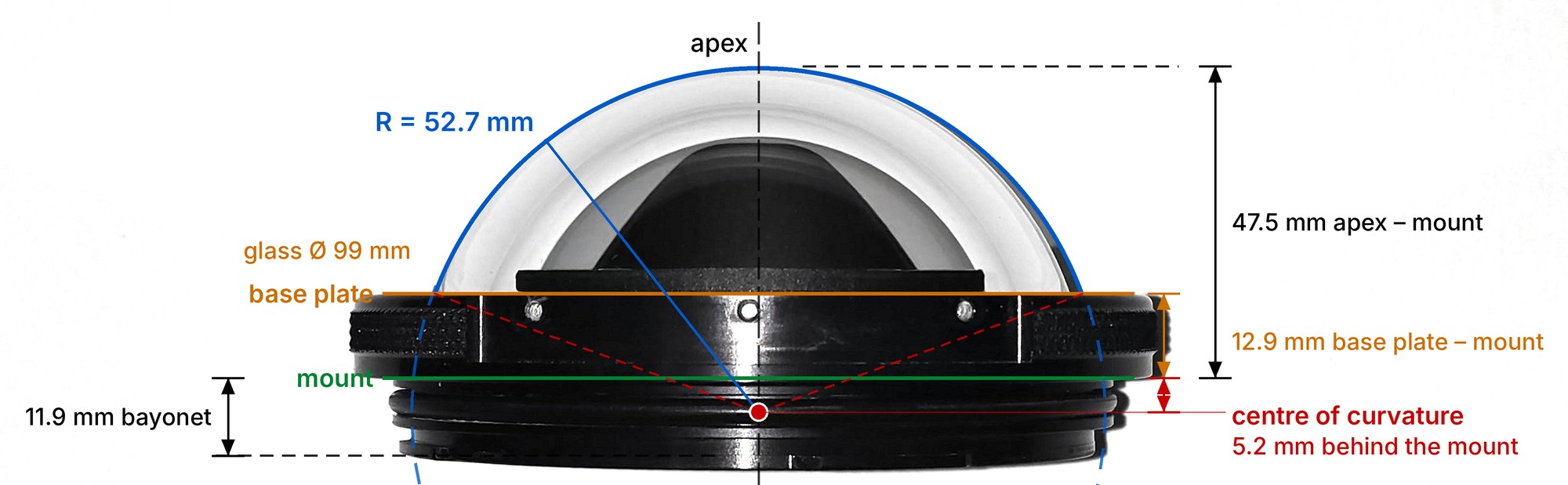
A dome port is a pressure-resistant, approximately spherical window of glass or acrylic. Its geometry is defined by the radius of curvature and the height of the spherical segment; together they set the opening angle.
3. The virtual image
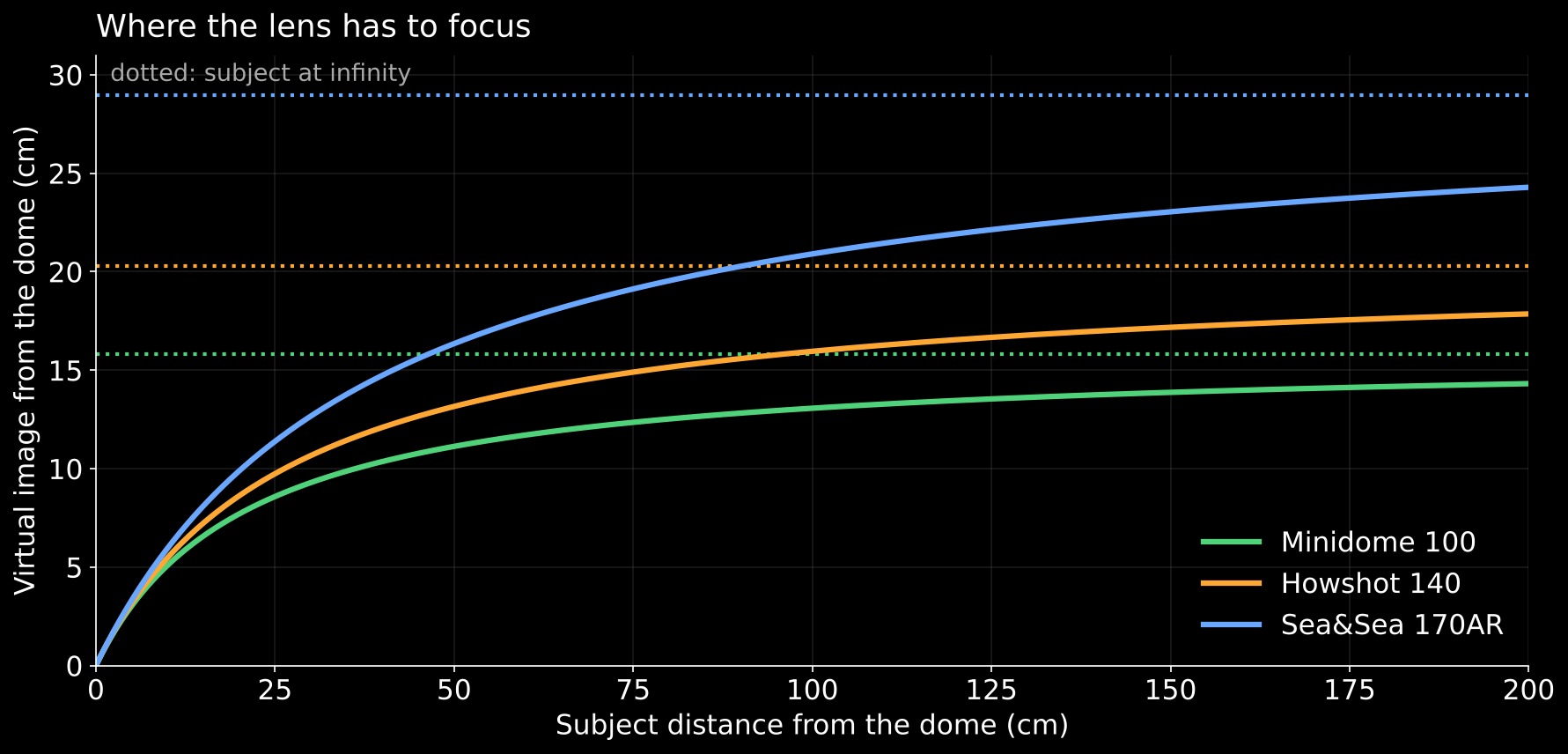
Underwater, the lens does not focus on the subject itself but on a virtual image formed by refraction at the dome. The dome acts as a weak negative lens. All subjects, from the glass surface to infinity, appear within a narrow range in front of the dome: a subject touching the glass appears at the glass, and a subject at infinity appears about three dome radii in front of the dome surface. For the Howshot 140 (radius 67.5 mm), everything from the glass to infinity is squeezed into the first 20 cm in front of the dome, for the Sea&Sea 170AR (radius 96.5 mm) into 29 cm.
The lens must therefore be able to focus that close. If it cannot, a subject near the dome cannot be made sharp. The options are a lens with a shorter minimum focus distance, an extension or close-up lens, or a dome with a larger radius.
4. Entrance pupil and dome centre
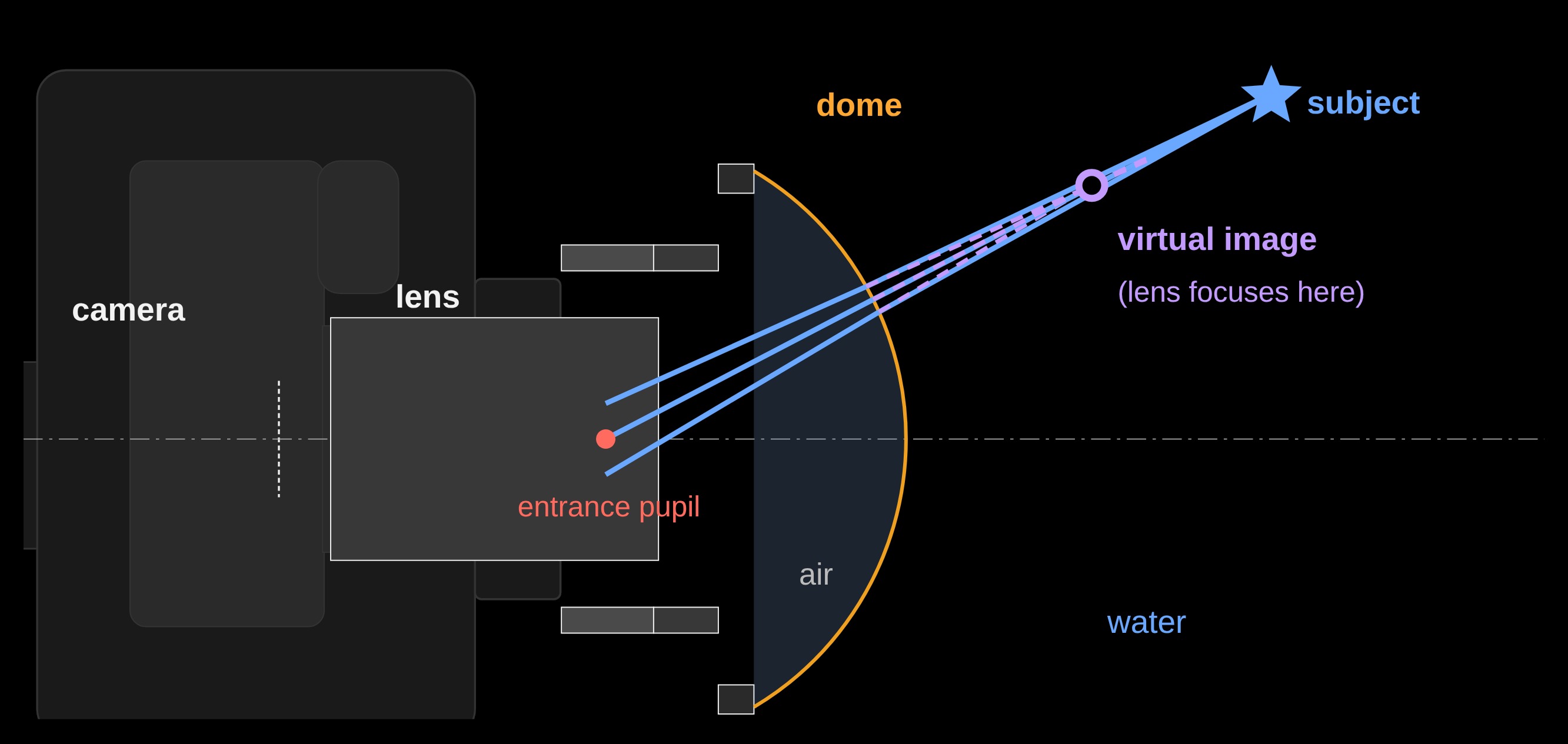
The dome works best when its centre of curvature sits exactly on the lens's entrance pupil, the point around which the lens "sees" the scene. Then every ray meets the dome at right angles and the dome adds almost no aberrations. If the two points are offset, astigmatism, field curvature and lateral colour increase toward the edges. The position is set with extension rings, and a few millimetres matter. The planner calculates the optimal extension for each dome, lens and focal length.
5. Dome size versus image quality
Larger domes are optically more forgiving, but they push the virtual image farther away. This reduces the maximum magnification for close-focus shots. They are also bulky, heavy and expensive. The aim is the smallest dome that still gives acceptable corners.
| Dome | Outer radius | Typical use |
|---|---|---|
| Aquatica Minidome 100 | 52.7 mm | Fisheye, CFWA |
| Howshot 140 | 67.5 mm | Fisheye (+TC) |
| Sea&Sea 170AR | 96.5 mm | Z 17–28 |
| Aquatica 6" | 80 mm | Fisheye, zoom |
| Ikelite 8" | 108 mm | Rectilinear zooms |
6. Field curvature: what the lenses really do
No lens images a flat wall perfectly flat. I measured the shape of the sharp surface in air with focus-shift series on a nodal rail. The camera was turned around the entrance pupil to 0°, 20°/25°, 35°/50° and 70°, with the chart 20 cm from the pupil. On a scale from 0 (flat plane) to 1 (sphere around the lens):
| Lens | Curvature |
|---|---|
| Fisheye 8–15, no TC | about 0.65 |
| Fisheye 8–15 + 1.4× TC | about 0.5 |
| Z 17–28 at 17 mm | 0.11–0.17 |
| Z 17–28 at 20–28 mm | 0.23–0.47 |
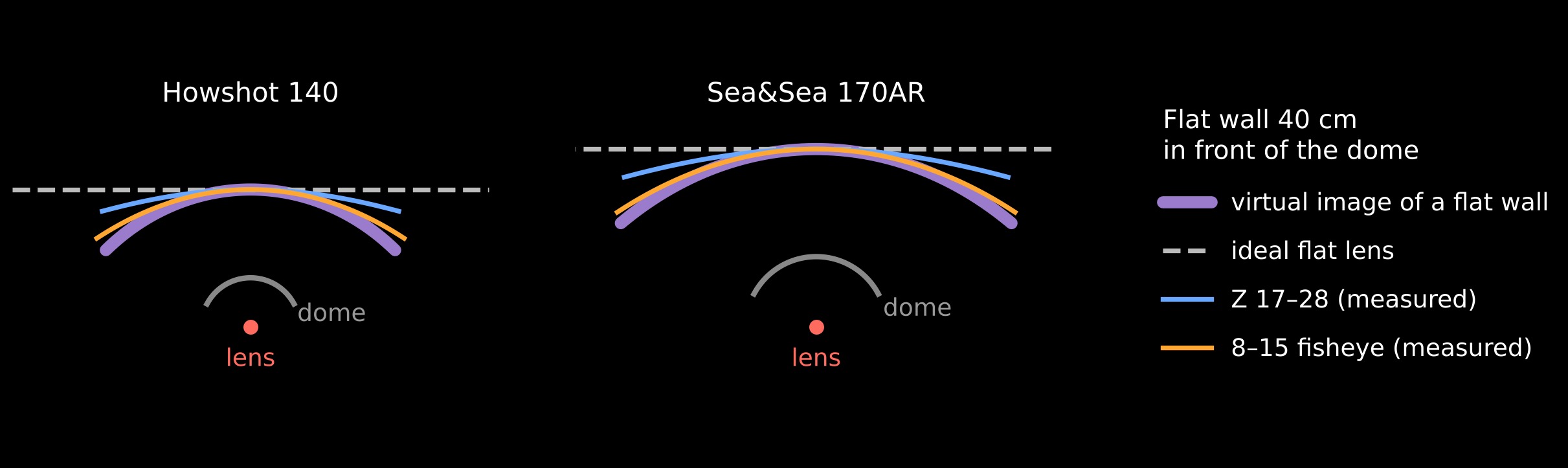
Both lenses curve toward the camera, the fisheye about halfway to a sphere, the 17–28 much less. Behind a dome this helps: the virtual image of a flat wall also curves toward the lens, so the lens's own curvature partly compensates for the dome. With the 17–28 in the 170AR at f/11–f/13, the planner predicts a flat wall sharp to the corners. A correction lens is therefore not needed there. At f/8 and 17 mm, the corners fall slightly outside the depth of field.
7. The teleconverter
Compared at the same effective focal length (15 mm without TC vs 11 mm on the ring with TC), the Kenko 1.4× TC costs no measurable sharpness at f/5.6. Toward the edges it is even slightly better, because it uses only the centre of the fisheye's image. At 15 mm on the ring (21 mm effective) the combination is softest. The real costs of the TC are one stop of light and a longer, heavier lens.
8. Sharpness and the diffraction limit
Sharpness was measured as the 10–90 % edge width: across a black-to-white edge, the distance over which brightness rises from 10 % to 90 %. On a Z8, about 2 px is the best a file shows.
At f/5.6 and best focus, both lenses reach about 2 px in the centre. Measured as detail on the subject, the 17–28 resolves 15–25 % finer detail at 20–40° off axis and almost twice as fine at 40–50°. Part of that comes from its projection, which spends more pixels on the edges. The fisheye, in turn, covers up to 90° off axis and still holds 3 px at 50–60°.
Underwater I use f/8–f/16, and there diffraction sets the limit. It blurs every lens by the same amount, depending only on the aperture:
| Aperture | Diffraction blur (Z8 pixels) |
|---|---|
| f/8 | 2.5 px |
| f/11 | 3.4 px |
| f/13 | 4.0 px |
| f/16 | 4.9 px |
| f/22 | 6.8 px |
From about f/11, both lenses look nearly the same in the file. Every stop beyond f/11 costs sharpness everywhere in the frame and pays off only where the depth of field is needed. In practice: f/8 where the depth of field allows it, f/11–f/13 as standard, f/16 only when necessary, f/22 never.
9. The dome port planner
The dome port planner combines these results. It draws the setup to scale, calculates the optimal extension, the closest focus, the depth of field and how much of a flat wall is sharp. It uses the measured field curvature of the 8–15 and the 17–28.
All measurements were made by me in air on a Nikon Z8 at 20 cm (tests of the domes in the pool are in preparation). They describe my copies of the lenses and are meant as a guide, not as a lens review.